Fragrance Brand
By LuxoPacks Factory Team July 2026
The bottle is picked. And then comes the question that stalls more indie fragrance launches than either of those: the box. In a typical r/DIYfragrance thread, a maker with thin 10 ml bottles — 0.6 by 4.8 inches — asks where to find a supplier who can do "nice custom printing" on a box that small. The answers usually split between "Etsy stock boxes" and "good luck under 1,000 units." Both are wrong, and this guide is the answer we give when that question lands in our factory inbox.
Perfume packaging is a special case among gift boxes because it has to do two jobs that pull in opposite directions: immobilize a heavy little glass vessel well enough to survive a courier network, and open like a counter at Selfridges. Get the second without the first and you'll be refunding chipped flacons. Here's how to spec both, with the real numbers — MOQs, unit costs, clearances — that a factory works from.
A rigid presentation box built on 1200-1800 gsm greyboard — the construction class most prestige perfume boxes use.
Scope: This guide covers the primary presentation box — the one the bottle lives in — for glass bottles from 5 ml discovery vials up to 100 ml flacons and multi-bottle coffrets. Outer shipping cartons are a separate topic. All prices are typical 2026 EXW factory-direct ranges; your dieline, finish list and quantity decide the real number, so treat these as planning figures and quote against your actual spec.
What a perfume box has to do (four jobs, in order)
Immobilize the glass
Measure the complete filled bottle, cap and any accessories rather than using a nominal fragrance size. Identify fragile shoulders, decorated surfaces and the intended display face. The insert should control movement without turning the cap, sprayer or label into an unintended load-bearing contact.
Survive the drop
Couriers drop parcels from waist height. The box and insert — not luck — absorb that energy.
Present the reveal
Fragrance is sold on ritual. The lid resistance, the interior color, the first sight of the bottle — all spec'd decisions.
Carry the legal text
Batch code, net contents, barcode, EU responsible person line — the artwork needs a home for all of it.
Check protection and product fit before optimizing the opening experience. A cavity or panel can be revised during development; discovering that mismatch after printing can require new inserts or a new box run.
The four structures that work for fragrance
A rigid box and a folding carton can both be considered for fragrance, but they create different presentation and packing systems. Compare each with its proposed insert and shipper. Retail distribution does not automatically require a carton, and a direct-to-consumer brand does not automatically need a rigid case.
Supporting detail: shoulder-neck rigid box page.
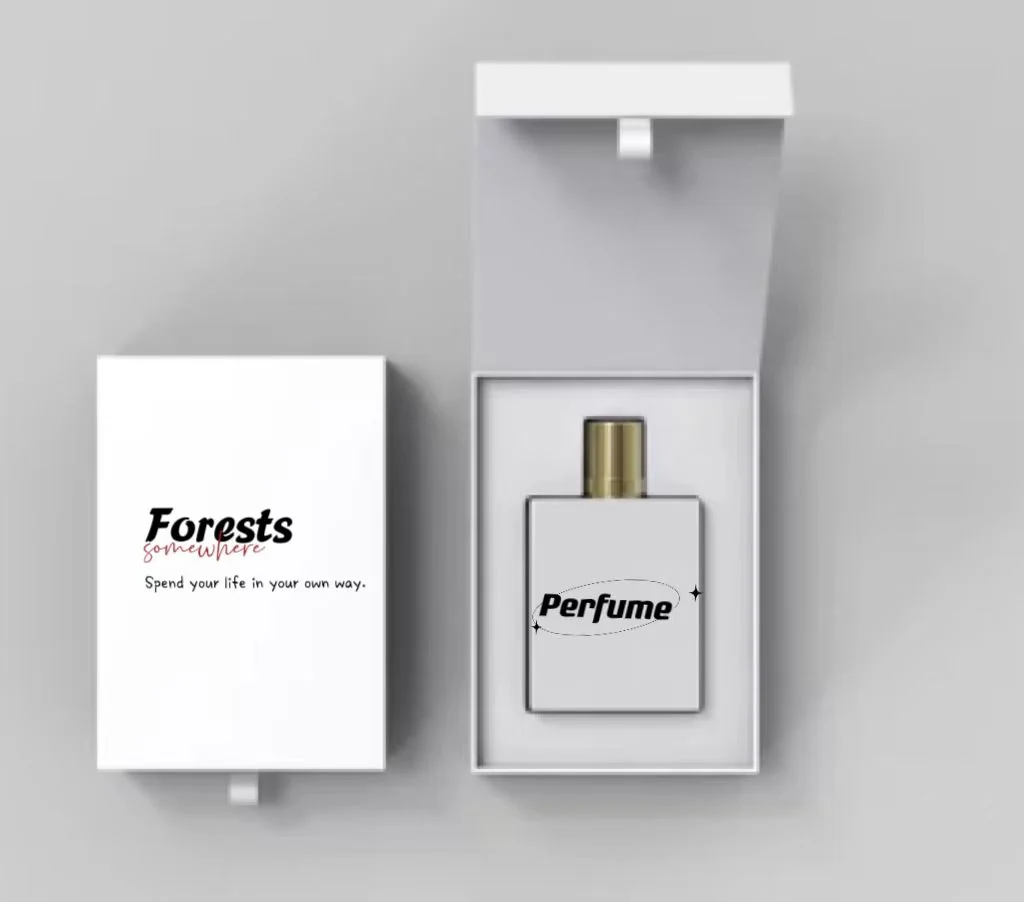
Lid-and-base two-piece. Simpler than shoulder-neck, still fully rigid, and the workhorse for 30-100 ml single bottles. Add a ribbon pull or wrist ribbon and it doubles as retail gifting. Construction details: lid & base rigid box with ribbon.
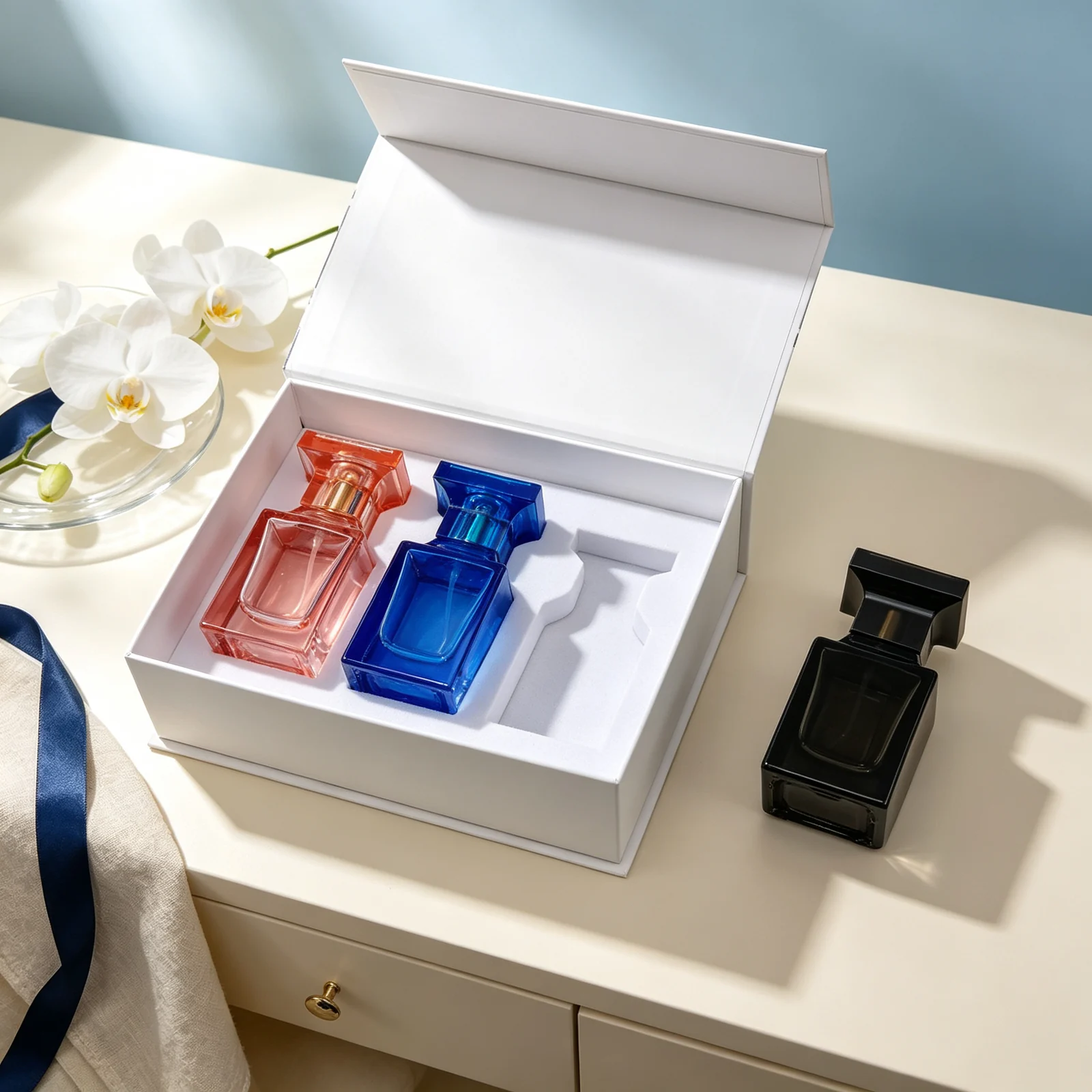
Magnetic closure box. The front flap opens like a book — theatrical, flat-laying, and the natural choice for coffrets and gift sets where the customer should see everything at once. Our magnetic rigid boxes start at 500 pieces, which is why they've become the default first custom box for indie brands.
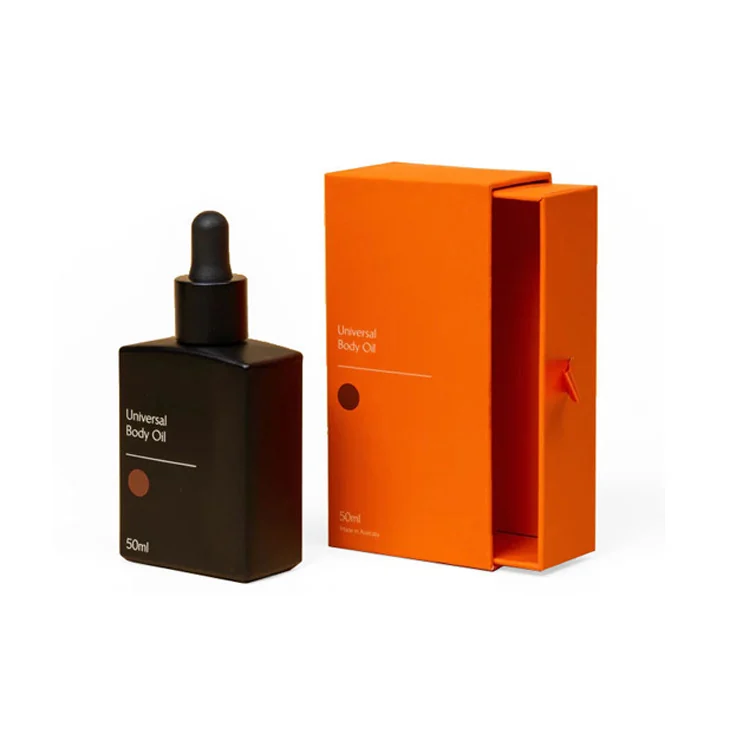
Sliding drawer box. For discovery sets — 5 to 10 small vials in a die-cut tray — a drawer box is thinner, cheaper, and slides through letterboxes, which matters if your discovery set ships untracked mail. The drawer action also survives repeated opening better than any hinge.
A printed folding carton (the thin paperboard box most designer perfumes at Sephora sit in) is the fifth option: lowest unit cost, prints beautifully, but it's a carton, not a rigid box — it needs an insert to protect glass and it won't be kept on a dresser. Fine for wide retail distribution; usually the wrong call for a DTC niche brand whose box is half the product story.
If your decision is specifically between a tuck carton and a rigid presentation box for a heavy glass bottle, use our perfume rigid box vs folding carton guide. It separates bottle, cap and insert mechanics from the visual idea of "luxury."
Size around the bottle — a worked example
Factories size perfume boxes from the bottle outward, and you should too. The arithmetic for a typical 50 ml flacon, 42 × 42 × 98 mm with the cap on:
- Cavity: bottle dimension + 2-3 mm total clearance → 44-45 mm square, 100-101 mm tall. Tighter and assembly slows down; looser and the bottle rattles.
- Insert walls: at least 10-12 mm of EVA around the cavity to absorb a corner drop → interior of roughly 66 × 66 × 112 mm.
- Box walls: rigid boxes are built on 2-3 mm greyboard plus wrap → external size lands near 72 × 72 × 120 mm.
Consider a six-vial discovery set using 10 ml vials measuring 15 × 122 mm. If each cavity is 17–18 mm wide and the five webs between six cavities are 8–10 mm, the row needs 142–158 mm before outer margins, while its other dimension must accommodate the 122 mm vial length. A 150 × 95 mm tray therefore should not be assumed to fit that single-layer arrangement. Recalculate the layout, finger access and edge margins from the real components; an outer depth under 35 mm also needs sample confirmation. Send the bottle drawing and required presentation to the manufacturer before approving a dieline.
Inserts: what actually holds the glass
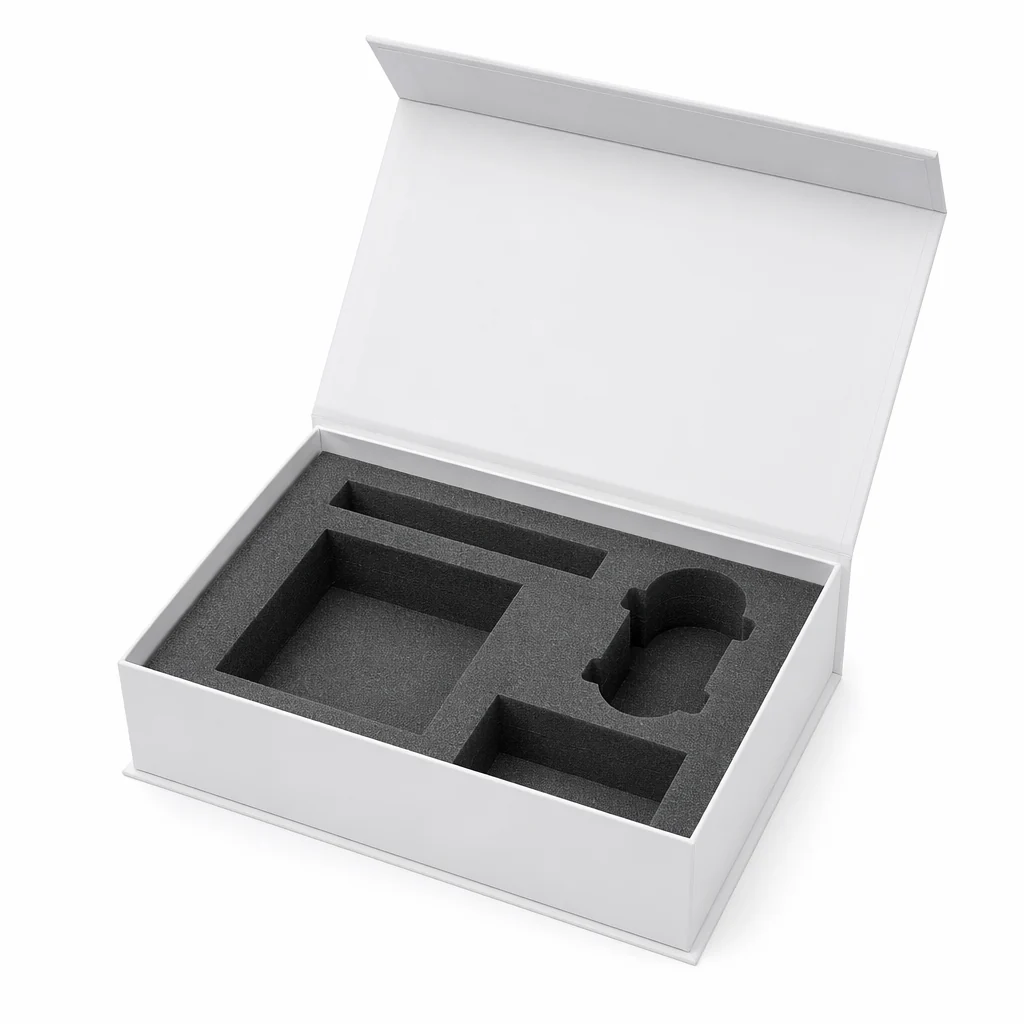
Die-cut EVA foam holds the vessel with 2-3 mm clearance — the difference between "arrived" and "arrived broken."
Four insert families matter for fragrance, in rough order of protection:
- Die-cut EVA foam — the protection benchmark for glass. Dense, precise cavities, available plain, flocked, or velvet-wrapped for prestige interiors.
- Velvet or satin-wrapped foam — same mechanics, dressed for the reveal. Standard in the $100+ tier.
- Molded paper pulp — plastic-free and increasingly what EU-focused brands request; fine thermoformed pulp now has a smooth, intentional surface that no longer looks like an egg carton.
- Card platforms — for folding cartons and light vials only; they position, but don't cushion.
Which one is right depends on bottle weight, sustainability positioning and budget — we've written a full comparison in our EVA foam vs molded pulp vs cardboard insert guide, and the materials guide tabulates the options. The short version: under 30 ml almost anything die-cut works; over 50 ml of glass, foam or fine pulp with real wall thickness.
Finishes that read "perfume counter"
The finish combination most ordered for fragrance: soft-touch lamination base + hot foil logo + blind emboss.
Fragrance buyers touch the box before they smell anything, so finish choices are commercial decisions, not decoration. The combination we cut most for perfume brands: soft-touch (velvet) lamination across the wrap, a hot-foil logo in gold, rose gold or holographic, and a blind emboss pattern or monogram. Soft-touch hides fingerprints — which matters for dark wraps — and foil gives the shelf glint that flat ink can't. Spot UV over a tone-on-tone pattern is the budget path to the same "there's something happening on this box" effect. One warning from production experience: heavy soft-touch plus deep emboss on very dark paper shows scuffs in transit, so ask your factory to sample your exact wrap before committing a full run — sample kits exist for exactly this. Our luxury finishes guide ranks each option by impact per dollar.
Don't forget the interior: a flood-printed inner wrap or a foil moment inside the lid costs little at print time and is what unboxing videos actually show.
What custom perfume boxes cost in 2026
| Construction | Typical 2026 EXW range | Typical MOQ | Best for |
|---|---|---|---|
| Printed folding carton + card insert | $0.55 – $1.20 | 500 pcs | Retail distribution, lighter vials |
| Folding carton + die-cut EVA | $0.90 – $1.80 | 500 pcs | Mid-tier DTC, 30–50 ml |
| Rigid lid-and-base / shoulder-neck + foam | $1.80 – $3.60 | 500 pcs | Prestige single flacon |
| Magnetic coffret, multi-cavity insert | $3.00 – $6.00 | 500 pcs | Gift sets, holiday coffrets |
Two anchors to calibrate against. First, a historical illustrative factory-cost model: a magnetic rigid box on a 200 × 200 × 80 mm basis was modeled at $3.50/unit at 100 pieces and $1.75 at 10,000, with the earlier illustrative volume curve stepping roughly −15% at 500, −25% at 1,000, −40% at 5,000 and −50% at 10,000. These figures preserve the old quantity-cost example; they are not current quotations or an available 100-piece production order. LuxoPacks starts at 500 pcs per design and size. Second, remember these are EXW numbers — ex-works, at the factory door. Freight, import duty and last-mile handling sit on top; our import duties and tariffs guide walks through the landed-cost math for US buyers, and the price guide lists finish surcharges line by line.
MOQ reality for small fragrance brands
LuxoPacks production starts at 500 pieces per design and size for both custom rigid boxes and printed folding cartons. Minimums elsewhere vary with the production route and specification; the number alone does not identify a reseller. If demand is below 500 pieces, compare available stock packaging or a different supplier's small-run option before committing to custom inventory. Keep one-time setup and reusable tooling charges separate when comparing the first order with a reorder.
Artwork and compliance: leave room for the boring panel
Before artwork goes to print, reserve one face — usually the base or back — for the text that regulators and retailers expect: net contents in both notations ("50 mL ℮ 1.7 FL.OZ."), batch/lot code position, EAN/UPC barcode with quiet zone, country of origin, and for EU sales the responsible-person name and address line. None of it is difficult; all of it is miserable to retrofit after a 5,000-unit print run. If your perfume is alcohol-based, note that dangerous-goods rules apply to the shipment (UN 1266, limited-quantity provisions), which shapes the master carton and carrier paperwork rather than the gift box itself — but your freight quotes will reference it, so it belongs in the same planning conversation. Use the print-ready artwork guide to check bleed, readable copy, panel placement and finish layers before printing. Have the destination-market labeling requirements checked against the exact fragrance product and pack.
Have bottle dimensions? That's all we need to start.
Send your bottle dimensions, filled weight and artwork for a design review. Request EXW quotations at 500 and 1,000 pieces per size and design, and agree the design schedule after specification review. Sample production normally takes 3–5 days after the sample requirements are confirmed.
From bottle spec to purchase order: the 7-step path
- Measure the bottle with the cap on — width, depth, height, and weight filled. Note the sprayer type; some over-caps need headroom.
- Pick the structure by channel: shoulder-neck or lid-and-base for single prestige flacons, magnetic for sets, drawer for discovery kits, folding carton for wide retail.
- Choose the insert by glass weight and brand positioning — foam for protection benchmark, fine molded pulp for plastic-free positioning.
- Set your quantity tier against a unit-cost target using the table above; ask for pricing at three quantities so you can see your own curve.
- Order a pre-production sample. LuxoPacks sample production normally takes 3–5 days after specification and artwork approval. Check bottle movement, removal and cap clearance with the actual filled bottle; agree any cavity adjustment and recheck the sample rather than applying a fixed 1 mm change.
- Approve artwork and confirm the production window — normally 15–25 days for bulk production after sample and order confirmation — then plan freight backward from the required arrival date.
Perfume is the category where packaging most directly is the product experience — the box outlives the last spray on most dressers. Spec it like an engineer, dress it like a creative director, and it will pay for itself in unboxing posts alone.
Frequently Asked Questions
What is the minimum order quantity for custom perfume boxes?
At a factory-direct maker like LuxoPacks, custom rigid perfume boxes start at 500 pieces and printed folding cartons at around 500 pieces. Trade printers and resellers often quote 500-1,000 pieces for the same construction. Below roughly 500 units, semi-custom stock boxes with a printed sleeve or hot-stamped logo are usually the smarter spend.
How much do custom perfume boxes cost in 2026?
Earlier reference scenarios below the current 500-piece minimum (not available for ordering)
This earlier quantity-and-price scenario is retained intact for comparison. It is not an available order option or current quotation.
Typical 2026 EXW factory-direct ranges: printed folding carton with a card insert runs about $0.55-1.20 per unit at 500+ pieces; a folding carton with die-cut EVA foam about $0.90-1.80; a rigid lid-and-base or shoulder-neck box with foam about $1.80-3.60; and a magnetic multi-bottle coffret about $3.00-6.00. Earlier illustrative comparison: LuxoPacks's magnetic rigid box runs $3.50 per unit at 100 pieces and $1.75 at 10,000 (200x200x80 mm basis). Freight, duties and finishes move the final landed number, so quote against your actual dieline.
Which box style is best for a perfume gift set or coffret?
Magnetic closure rigid boxes and lid-and-base two-piece boxes are the standard for multi-bottle coffrets because they open flat for counter presentation and take a multi-cavity EVA or molded pulp insert. For discovery or sample sets of 5-10 small vials, a sliding drawer box with a die-cut tray is usually cheaper, thinner, and easier to post through letterboxes.
How do I stop perfume bottles breaking or leaking in transit?
Immobilize the bottle: a die-cut insert cavity should hold the flacon with about 2-3 mm total clearance so nothing rattles. Run a shake test on your pre-production sample - if you can hear the bottle move, the cavity is oversize. Support the shoulder and base of the bottle, keep the sprayer clear of pressure, ship boxes upright in a corrugated master carton with dividers, and remember alcohol-based perfume is a dangerous good for air transport, which affects the outer shipment, not the gift box itself.
How long does custom perfume packaging take to produce?
At LuxoPacks, agree the design scope and schedule after specification review. Sample production normally takes 3–5 days, with bulk production normally taking 15–25 days after sample and order confirmation. Earlier planning examples allowed 25–35 days for ocean freight, 5–10 days for air transit and 8–10 weeks overall; these are route-dependent assumptions, not guaranteed delivery times. Obtain a current logistics schedule and allow for revisions, customs and holiday closures.
LuxoPacks is a custom rigid box manufacturer in Dongguan, Guangdong, with 18 years of packaging experience. Production orders start at 500 pcs per design and size. Related reading: Perfume Packaging Solutions, EVA Foam vs Molded Pulp vs Cardboard Inserts, Luxury Packaging Finishes Guide, Gift Box Size Guide, MOQ Guide.
Put this guide into practice
Approve the filled bottle in its insert and final box, including the way it is lifted out. Compare quotations for that complete pack instead of buying a structure from an empty-box photograph.